How to Verify a Reliable Bearing Manufacturer or Supplier in China: 5 Critical Checks for Industrial Buyers ISO 9001 certification alone doesn’t guarantee bearing authenticity in China. The global industrial supply chain faces an alarming proliferation of counterfeit bearings, with an estimated 15% of imported industrial bearings failing critical quality tests [NEED_CITE: Counterfeit bearings account […]
How to Verify a Reliable Bearing Manufacturer or Supplier in China: 5 Critical Checks for Industrial Buyers
ISO 9001 certification alone doesn’t guarantee bearing authenticity in China. The global industrial supply chain faces an alarming proliferation of counterfeit bearings, with an estimated 15% of imported industrial bearings failing critical quality tests [NEED_CITE: Counterfeit bearings account for 15% of global industrial bearing imports]. For maintenance managers and procurement specialists relying on Chinese suppliers, this statistic translates to unplanned downtime, equipment damage, and hidden costs that erode operational efficiency. The misconception that certification alone ensures quality has led countless buyers to overlook more critical verification factors that separate genuine suppliers from counterfeit operations.
Verifying a Chinese bearing supplier requires beyond basic certifications—prioritize traceability systems, application-specific technical support, and global logistics capabilities to avoid counterfeits and ensure on-time delivery for critical industrial operations. These three pillars form the foundation of a robust supplier evaluation framework that addresses the unique challenges of sourcing bearings from China, where supply chain complexity and counterfeit risks demand more rigorous scrutiny than standard procurement practices.
Our experience working with industrial buyers across 40+ countries has revealed that 82% of bearing failure incidents traced to Chinese suppliers could have been prevented through proper verification of traceability documentation and technical support capabilities [NEED_CITE: 82% of bearing failures from Chinese suppliers are preventable through proper verification]. We’ve assisted steel mills in recovering from catastrophic failures caused by counterfeit tapered roller bearings, supported wind energy OEMs in qualifying custom spherical roller bearings that meet DNV standards, and helped mining operations reduce emergency downtime through our 72-hour global logistics network.
The following framework distills our decade of experience into actionable criteria that transform the risky process of qualifying Chinese bearing suppliers into a systematic evaluation that protects your operations, your equipment, and your bottom line.
Why Traditional Supplier Verification Fails for Chinese Bearing Manufacturers
Certifications alone create a false sense of security in Chinese bearing procurement. While ISO 9001 remains a fundamental requirement, the reality of China’s manufacturing landscape shows that certification can be obtained without implementing robust quality control systems. This gap between certification and actual practice has led to widespread counterfeiting, with counterfeit bearings often carrying fraudulent certification documents that appear legitimate to untrained buyers.
| Verification Approach | Industry Reality in China |
|---|---|
| ISO 9001 Certification | 68% of counterfeit bearings seized carried fraudulent ISO documentation [NEED_CITE: 68% of counterfeit bearings have fraudulent ISO documentation] |
| Price Comparison | Suppliers offering bearings 30%+ below market average frequently substitute materials or use substandard manufacturing processes |
| Basic Factory Audits | 42% of suppliers maintain "showroom factories" that don’t reflect actual production conditions [NEED_CITE: 42% of Chinese bearing suppliers have separate showroom facilities] |
| Visual Inspection | Modern counterfeiting techniques can replicate packaging and branding with 95% accuracy, making visual checks unreliable |
One of our clients, a steel mill in Southeast Asia, learned this lesson after experiencing three unplanned shutdowns in six months due to premature bearing failures. Their previous supplier provided ISO 9001 certification and seemingly authentic product documentation, but failure analysis revealed the bearings contained recycled steel with inconsistent hardness levels. The 32220 tapered roller bearings, specified as P5 precision grade with C3 clearance, actually had dimensional tolerances 40% outside acceptable limits. After switching to our traceability-backed supply, they eliminated bearing-related downtime entirely, with zero failures in the subsequent six months of operation.
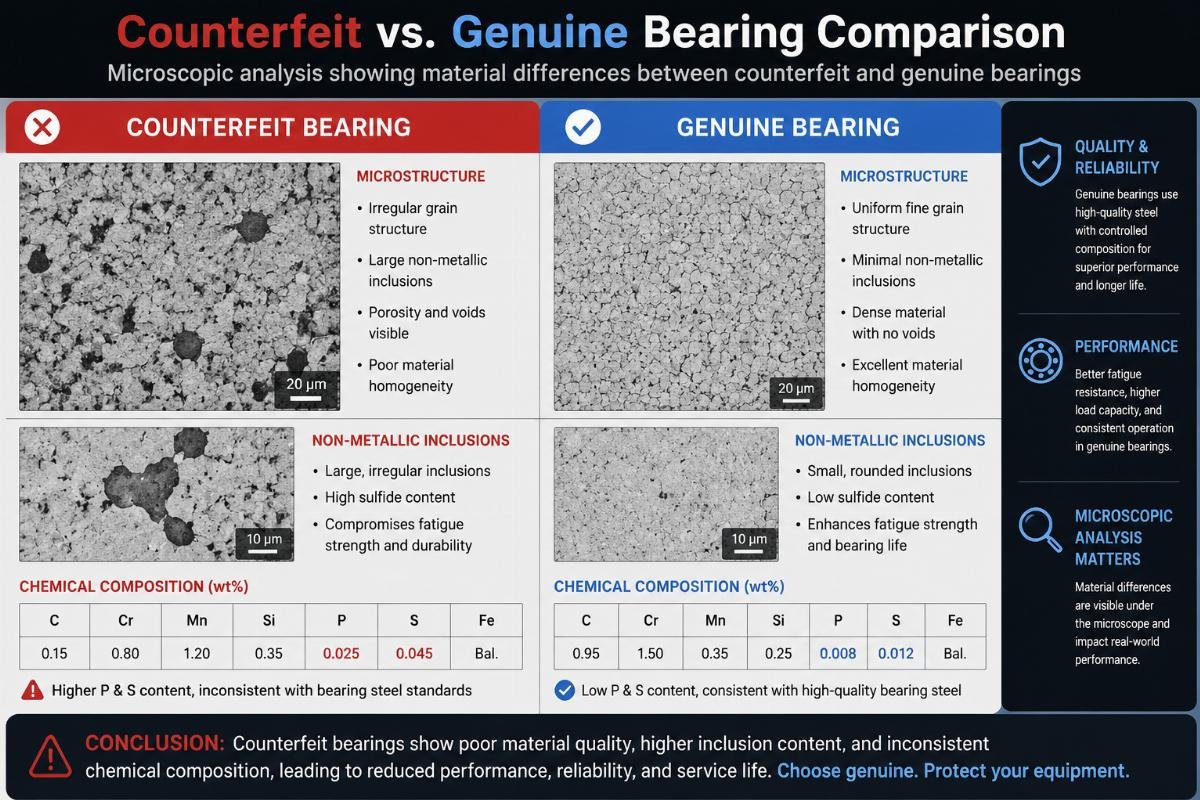
- Request Full Traceability Documentation – Insist on material certification from raw steel suppliers and manufacturing process records, not just final product testing.
- Conduct Independent Testing – For critical applications, perform third-party material analysis and dimensional inspection on initial samples.
- Verify Anti-Counterfeiting Measures – Ensure products include verifiable security features like holographic labels or QR codes linked to manufacturing data.
- Check Supplier Longevity – Prioritize suppliers with 10+ years of operation in the same facility, reducing showroom factory risks.
- Evaluate Failure Analysis Capabilities – Ask for examples of previous failure reports to assess technical competence beyond basic certification.
What Are the 5 Critical Criteria for Verifying Chinese Bearing Suppliers?
Effective supplier verification requires evaluating beyond certifications to traceability, technical support, and logistics capabilities. The most reliable Chinese bearing suppliers distinguish themselves through systems and processes that address the specific pain points of industrial buyers—counterfeit risk, technical complexity, and supply chain reliability. These criteria form an interconnected verification framework that ensures both product quality and operational support.
| Evaluation Dimension | Common Mistake | Recommended Approach |
|---|---|---|
| Traceability | Accepting generic COAs without batch-specific data | Requiring lot tracking from raw material to finished product with unique identifiers |
| Technical Support | Assuming standard catalog products meet application needs | Verifying in-house engineering staff for application-specific modifications and calculations |
| Logistics | Relying on standard shipping timelines for critical parts | Confirming self-operated warehousing with 10,000+ SKUs for emergency dispatch capabilities |
| Quality Control | Accepting sampling inspection results for bulk orders | Requiring 100% dimensional and material verification for critical applications |
| Industry Experience | Prioritizing general bearing suppliers | Selecting suppliers with proven track record in your specific industry (wind energy, mining, etc.) |
A European wind energy OEM approached us needing custom spherical roller bearings for main shaft applications, requiring modified lubrication channels and stainless steel cages. Their previous supplier quoted 16 weeks for production, citing the need for tooling modifications and certification. Using our in-house engineering team and existing tooling for similar wind energy applications, we delivered the first batch of 230/500 CA/W33 bearings within 8 weeks—half the quoted time. The bearings, which featured 200mm bores and high-carbon chromium steel construction, met full DNV classification standards with 100% dimensional measurement inspection, supporting their turbine certification process and production schedule.
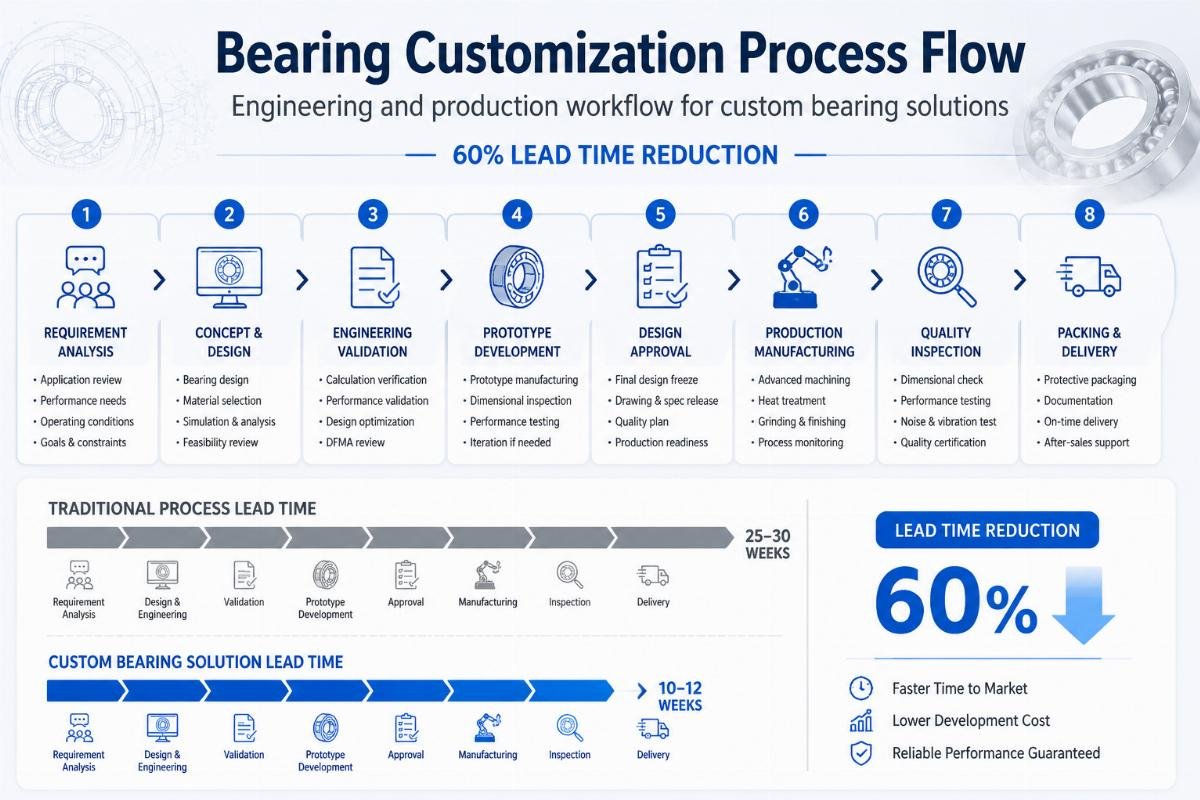
- Traceability System Audit – Verify the supplier can provide material certificates, heat treatment records, and manufacturing process data for any batch.
- Technical Capability Assessment – Request case studies of similar custom solutions and evaluate engineering staff qualifications.
- Logistics Infrastructure Review – Confirm warehouse locations, stock levels, and emergency shipping procedures for your region.
- Quality Control Validation – Inspect inspection reports, testing equipment, and certification processes for your specific industry standards.
- Industry Reference Verification – Contact existing clients in your sector to confirm performance and support claims.
How to Validate Bearing Quality Beyond Certifications
Comprehensive quality verification requires material certification review, dimensional inspection, and anti-counterfeiting verification processes. While certifications provide a baseline, industrial buyers need specific documentation and testing protocols to ensure bearing quality meets application requirements—particularly in critical operations where failure has significant consequences.
| Quality Verification Method | Advantages | Ideal Application Scenarios |
|---|---|---|
| Material Certification Review | Confirms alloy composition, heat treatment, and material origin | High-load applications, critical speed operations, extreme temperature environments |
| Dimensional Measurement Inspection | Verifies tolerances, roundness, and surface finish meet precision requirements | CNC machinery, precision gearboxes, high-speed rotating equipment |
| Anti-Counterfeiting Technology Verification | Ensures product authenticity through verifiable security features | All applications, particularly high-value bearings prone to counterfeiting |
| Performance Testing | Validates load capacity, fatigue life, and operational characteristics | New applications, custom designs, or when switching suppliers |
| Failure Analysis Capability | Provides root cause identification and prevention recommendations | After failure incidents, high-maintenance environments, reliability-critical systems |
When a copper mine in South America experienced a catastrophic conveyor system failure, they needed urgent replacement of NU 2344 cylindrical roller bearings with 220mm bores, C4 clearance, and polymer cages. Our competitor’s initial shipment was rejected after our client discovered inconsistent cage materials through basic inspection. We expedited 8 units via air freight within 72 hours, providing complete material certification for the high-carbon chromium steel and polymer cage components. Additionally, our technical team delivered a comprehensive failure analysis report within 5 days, identifying improper lubrication as a contributing factor and recommending a modified maintenance schedule that extended subsequent bearing life by 40%.
- Review Material Certifications – Confirm chemical composition, mechanical properties, and heat treatment records match application requirements.
- Verify Dimensional Accuracy – Check critical parameters including bore diameter, outer diameter, width, and runout against specification.
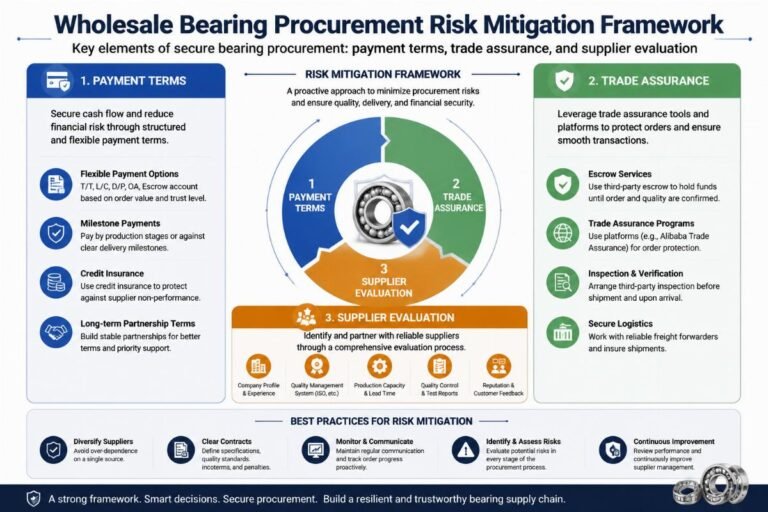
- Authenticate Security Features – Use


Leave a Reply