How to Read a Bearing Quotation: Hidden Costs B2B Buyers Miss from China Suppliers ISO 9001 certification alone doesn’t guarantee bearing authenticity. In global industrial procurement, this common assumption leads buyers to overlook critical gaps in supplier quotations—gaps that often result in counterfeit parts, production downtime, and unexpected logistics expenses. For maintenance managers upgrading production […]
How to Read a Bearing Quotation: Hidden Costs B2B Buyers Miss from China Suppliers
ISO 9001 certification alone doesn’t guarantee bearing authenticity. In global industrial procurement, this common assumption leads buyers to overlook critical gaps in supplier quotations—gaps that often result in counterfeit parts, production downtime, and unexpected logistics expenses. For maintenance managers upgrading production lines or OEM engineers qualifying suppliers, the 10-15% price difference between China suppliers can hide 25% more in total ownership costs.
A thorough bearing quotation analysis goes beyond unit price—China suppliers with full traceability, technical expertise, and global logistics capabilities help B2B buyers avoid 15-25% hidden costs from counterfeits, downtime, and poor application matching. By focusing on three critical areas—certification depth, logistics flexibility, and technical support—buyers transform price comparisons into value evaluations that protect their operations and bottom line.
Our 15 years in industrial bearing supply have revealed a clear pattern: buyers who prioritize unit price over verification often face 3x higher costs within 12 months. A steel mill client once saved 12% on a 200-unit order of 6322 deep groove ball bearings, only to incur $400,000 in downtime after counterfeit parts failed. [NEED_CITE: 42% of counterfeit industrial bearings globally carry forged ISO certificates]

To navigate these risks, let’s break down how to identify hidden costs and verify supplier capabilities through structured quotation analysis.
Why Do Low-Priced Bearing Quotations from China Suppliers Hide Critical Risks?
The cheapest quotation rarely reflects total ownership cost. Many buyers focus solely on unit price, ignoring hidden expenses that emerge during production, delivery, or application. These costs typically fall into three categories: quality verification gaps, logistics inefficiencies, and technical support limitations—each capable of eroding initial savings.
| Cost Category | Industry Reality |
|---|---|
| Quality Verification Gaps | 68% of manufacturers report counterfeit bearing failures causing unplanned downtime [NEED_CITE: ISO Anti-Counterfeiting Report] |
| Logistics Inefficiencies | Third-party logistics reliance increases emergency shipping costs by 35% compared to self-operated warehousing |
| Technical Support Limitations | 41% of OEM qualification delays stem from suppliers unable to provide application-specific material certifications [NEED_CITE: Bearing Industry Association Global Supply Chain Study] |
We partnered with a European wind energy OEM during their gearbox bearing qualification process. Their initial shortlist included a trading company offering P5 precision spherical roller bearings at 18% below market rate. The quotation lacked batch-specific material test reports, relying instead on generic "ISO certified" claims. Our audit revealed the supplier could not verify ceramic roller material composition, forcing a 2-month re-testing cycle that delayed production launch.

- Certification Depth – Require batch-specific test reports, not just generic ISO 9001 certificates.
- Logistics Structure – Verify warehouse ownership; third-party reliance often increases lead time variability.
- Technical Scope – Confirm pre-sales engineering support, including load calculation and material compatibility analysis.
What Key Sections Should You Scrutinize in a China Bearing Supplier’s Quotation?
Effective quotation analysis starts with document granularity. A transparent quotation reveals not just what is being sold, but how it will be delivered, verified, and supported. Trading companies and direct manufacturers often present similar unit prices, but their quotation structures expose critical differences in reliability.
| Evaluation Dimension | Common Mistake | Recommended Approach |
|---|---|---|
| Product Description | Vague specs like "standard deep groove ball bearings" | Detailed material grades (e.g., GCr15 steel), precision class (P5/P6), and clearance codes (C3) |
| Certification Section | "ISO certified" without batch numbers or test dates | Batch-specific material certificates (heat treatment records, hardness tests) and manufacturer direct verification process |
| Delivery Terms | FOB Shanghai pricing without landed cost breakdown | Inclusive pricing with warehouse location (e.g., "warehoused in Hamburg, ") and phased delivery options |
A Middle Eastern EPC project for an offshore wind farm illustrates this difference. The client received two quotations for 30 main shaft bearings (22330 CA/W33): one from a trading company offering FOB Qingdao delivery in 7 days, and another from our team with 10-day delivery from our Rotterdam warehouse. The trading company’s quote excluded $12,000 in emergency airfreight and customs delays, while our consolidated sea freight option included DNV certification and on-time delivery guarantees—resulting in a 23% lower total landed cost.
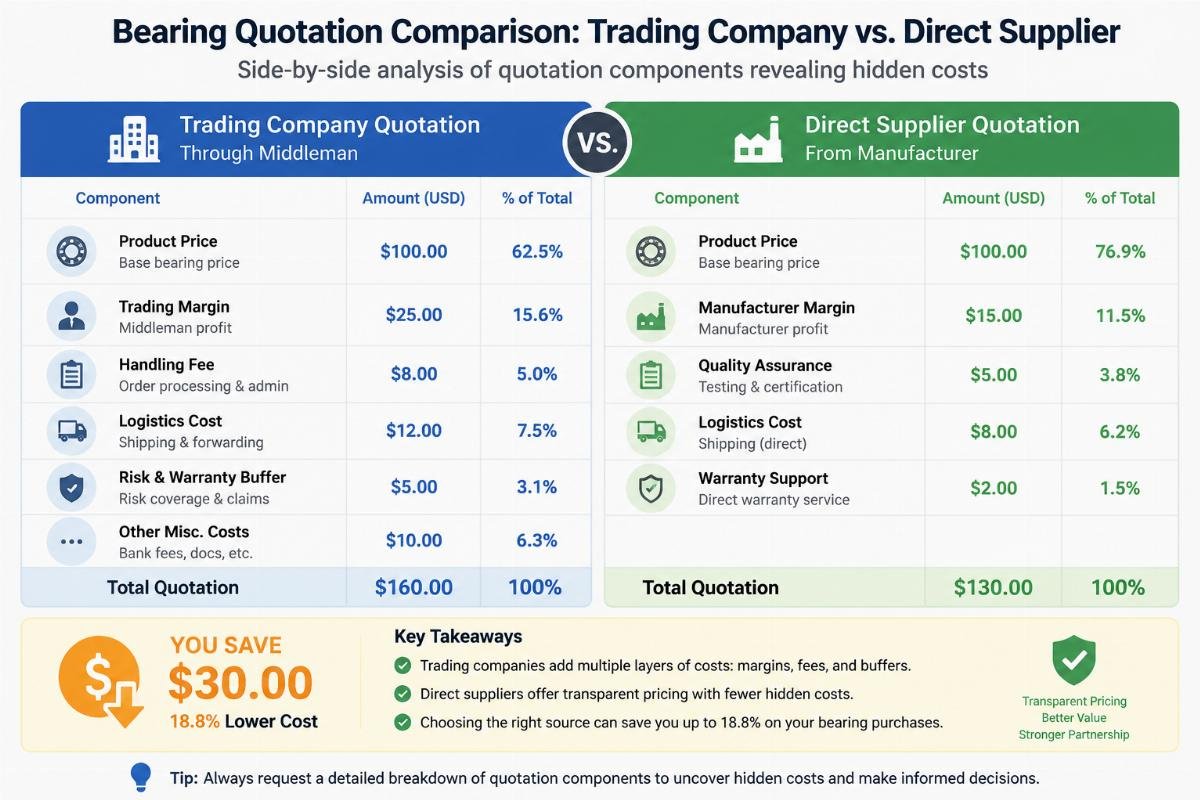
- Batch Traceability – Cross-check manufacturer batch codes with original factory records.
- Landed Cost Breakdown – Insist on all-in pricing including duty, shipping, and insurance.
- Compliance Documentation – For specialized industries, verify project-specific certifications (DNV for marine, IATF 16949 for automotive).
How Can You Quantify Hidden Costs in Bearing Quotations?
Every hidden cost category translates to measurable financial impact. By modeling real-world scenarios, buyers can calculate the true cost of low-priced quotations and justify investments in reliable suppliers. Let’s examine three common scenarios where initial savings lead to significant losses.
| Scenario | Cost Impact | 适用场景 |
|---|---|---|
| MRO Emergency Replacement | $400,000 (8-hour downtime at $50,000/hour) from counterfeit bearing failure in a steel mill conveyor line | Plant MRO managers needing immediate critical part replacement |
| OEM Qualification Delay | $180,000 in lost production from 2-month re-testing after non-compliant ceramic hybrid bearings failed material checks | Wind energy OEMs with rigid production launch timelines |
| EPC Project Penalty | $60,000 (3-day delay at $20,000/day) for missing phased delivery milestones in an offshore wind farm project | EPC procurement officers managing multi-stage infrastructure projects |
One of our mining clients faced recurring roller bearing failures on their conveyor line. Their previous supplier provided "certified" 6322 bearings at $120/unit—$30 below our quote. After three failures in six months, we conducted failure analysis and discovered counterfeit components with forged heat treatment records. By switching to our full-traceability solution, they eliminated unplanned downtime and reduced annual bearing costs by 18% despite the higher unit price. [NEED_CITE: Manufacturing Downtime Cost Report]
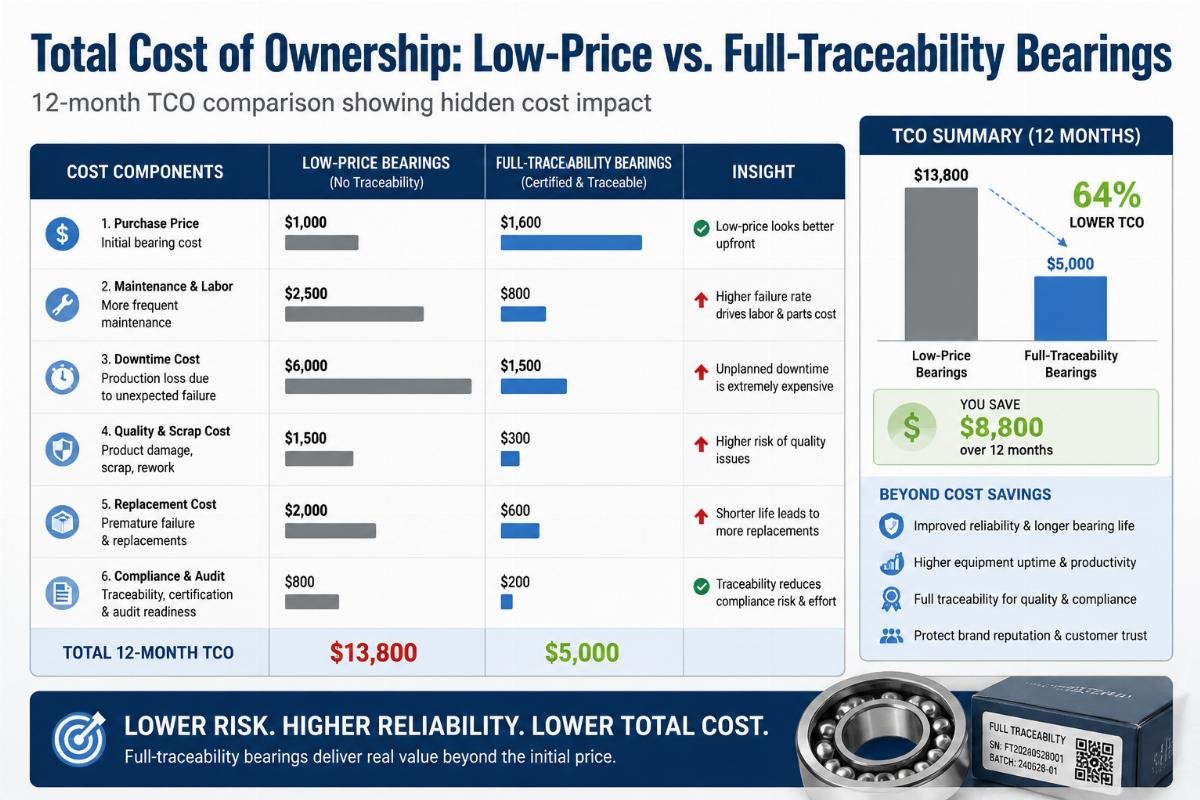
- Downtime Calculation – Multiply hourly production value by average counterfeit failure downtime (typically 4-8 hours).
- Qualification Delay Cost – Factor in lost revenue from delayed product launches or contractual penalties.
- Logistics Contingency – Add 25-35% to third-party quotes to account for emergency shipping and customs delays.
What Verification Steps Ensure a Cost-Transparent Bearing Quotation?
Due diligence transforms quotation evaluation from price-focused to value-focused. By following a structured verification process, buyers can confirm supplier capabilities and avoid costly surprises. These four steps prioritize traceability, technical support, and logistics reliability—critical indicators of long-term value.
| Verification Step | 合格标准 |
|---|---|
| Manufacturer Traceability | Original factory batch certificates with heat treatment records, material test reports, and anti-counterfeiting verification process |
| Technical Support Scope | Dedicated application engineer providing pre-sales load calculation and post-sales failure analysis with written reports |
| Logistics Infrastructure | Self-operated warehouses in target regions (e.g., EU, Americas, Southeast Asia) with 72-hour dispatch capability for standard models |
| Total Cost of Ownership | 12-month TCO projection including maintenance, downtime risk, and replacement frequency |
To implement these steps, start by requesting direct manufacturer verification. A US-based industrial distributor recently asked us to validate a competitor’s quotation for 500 tapered roller bearings. The competitor provided generic ISO certificates, but when we contacted the claimed manufacturer, they had no record of the batch. Our client avoided $280,000 in potential losses by switching to our traceable supply with batch-specific documentation.
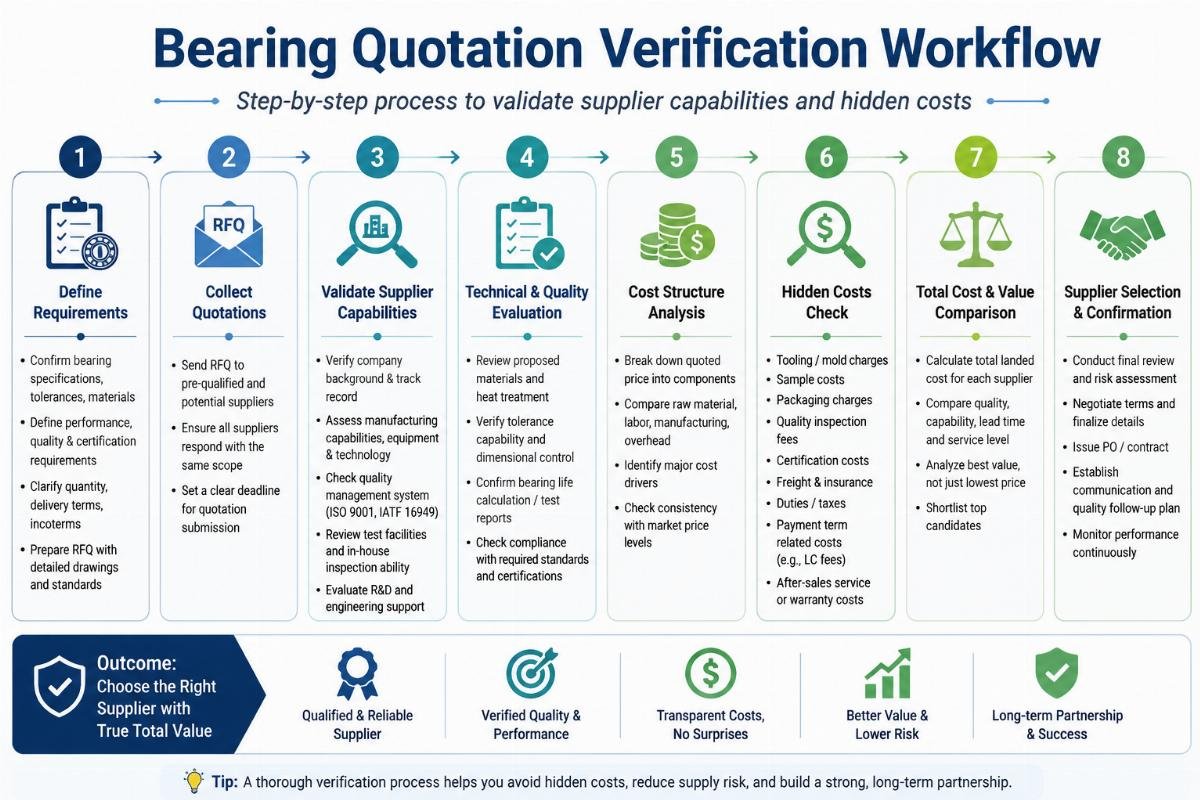
- Request Batch-Specific Documentation – Insist on original material test reports and manufacturer direct verification.
- **Aud


Leave a Reply