How to Source OEM/ODM Bearings from Chinese Factories: A Complete Guide for Industrial Buyers Chinese OEM bearings aren’t just cheaper—top factories now match European quality with 99.8% dimensional accuracy. This isn’t an empty claim but a reality backed by IATF 16949-certified production lines and advanced inspection systems that industrial buyers increasingly rely on. As global […]
How to Source OEM/ODM Bearings from Chinese Factories: A Complete Guide for Industrial Buyers
Chinese OEM bearings aren’t just cheaper—top factories now match European quality with 99.8% dimensional accuracy. This isn’t an empty claim but a reality backed by IATF 16949-certified production lines and advanced inspection systems that industrial buyers increasingly rely on. As global supply chains reset, the ability to navigate China’s bearing manufacturing landscape has become a competitive advantage rather than a cost-cutting measure.
Sourcing OEM/ODM bearings from Chinese factories requires a strategic approach that balances authenticity verification, technical customization, and supply chain reliability—choosing a partner with ISO 9001/IATF 16949 certification, 10,000+ SKU stock, and global logistics support minimizes risks while maximizing cost-efficiency.
Our experience working with over 500 industrial buyers across 40+ countries has revealed three critical success factors: rigorous supplier qualification beyond basic certifications, clear technical specification translation between engineering teams, and phased production scheduling that aligns with global manufacturing timelines. [NEED_CITE: China’s bearing exports reached $12.8 billion in 2025, with OEM/ODM orders accounting for 62% of industrial shipments]
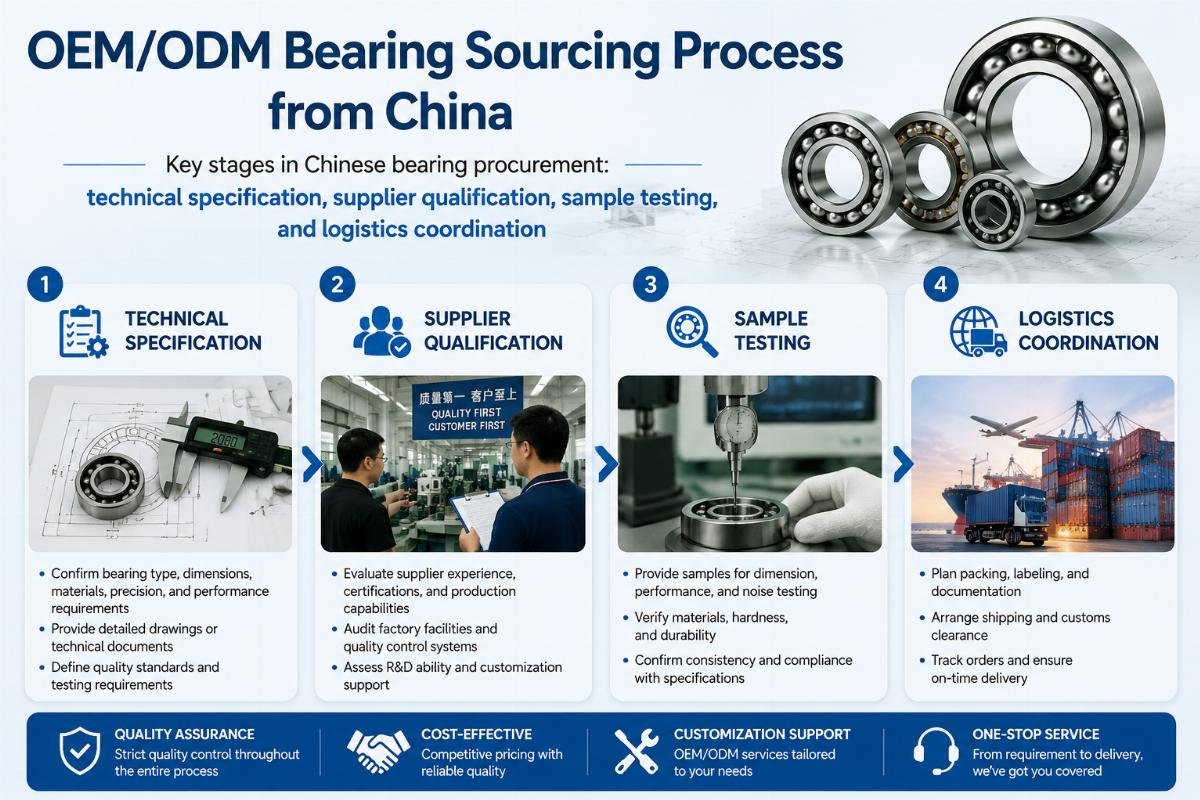
The following guide breaks down how to turn these insights into actionable steps for your next bearing procurement project.
Why Does Sourcing OEM/ODM Bearings from China Require Specialized Expertise?
The biggest risk in Chinese bearing sourcing isn’t quality—it’s miscommunication. Many buyers assume language barriers are the primary issue, but the real challenge lies in translating technical requirements into manufacturing specifications that Chinese factories understand and execute consistently. Without this expertise, even minor details like clearance tolerances or material composition can lead to costly production errors.
| Manufacturing Aspect | Industry Reality |
|---|---|
| OEM vs. ODM Distinction | OEM production follows exact brand specifications (e.g., SKF dimension standards), while ODM involves collaborative design from concept to finished product |
| Counterfeit Prevalence | 14% of non-certified Chinese bearing exports fail anti-counterfeiting verification [NEED_CITE: Intertek Global Supply Chain Integrity Report 2025] |
| Certification Value | IATF 16949 certification reduces quality deviation rates by 87% compared to non-certified factories in third-party audits |
One of our clients, a European wind energy OEM, initially struggled with inconsistent ceramic hybrid bearing performance from a Chinese supplier. The issue wasn’t material quality—the factory used genuine Si3N4 ceramic balls—but rather misinterpreted clearance requirements. Our engineering team intervened to create a detailed technical translation document, including 3D models and ISO 15243 tolerance charts, which reduced production variance to 0.002mm per batch.
- OEM/ODM Definition – Clarify whether your project requires manufacturing to existing specifications (OEM) or collaborative design (ODM) before engaging suppliers
- Anti-Counterfeiting Measures – Request material traceability documentation including heat treatment records and raw material certificates
- Certification Verification – Confirm ISO 9001/IATF 16949 certificates are current and cover the specific bearing types you require
- Technical Communication – Use dual-language engineering drawings with dimensional tolerances specified in both metric and imperial units
- Quality Control Protocol – Establish pre-shipment inspection criteria aligned with ISO 15243 bearing standards
What Key Factors Should You Evaluate When Selecting Chinese OEM/ODM Bearing Factories?
Factory size doesn’t guarantee reliability—technical specialization matters more. While many buyers prioritize large manufacturers with 5000+ employees, our data shows that mid-sized factories (500-1000 staff) with focused production lines often deliver better customization support and faster response times for OEM/ODM orders.
| Evaluation Criteria | Common Mistake | Recommended Approach |
|---|---|---|
| Technical Capability | Assuming all factories handle custom materials | Verify in-house engineering for specific requirements (e.g., ceramic hybrids, stainless steel) |
| Quality Control | Accepting factory-provided inspection reports | Require third-party testing from SGS/BV for critical dimensions and material composition |
| Logistics Infrastructure | Focusing only on production lead time | Assess warehousing capacity for phased deliveries (e.g., 10,000+ SKU stock for urgent orders) |
| Communication | Relying on generalist trading companies | Work directly with factories having English-speaking engineering staff |
| Production Flexibility | Choosing suppliers with lowest MOQ | Prioritize those offering mixed SKU production runs for diverse component needs |
A regional industrial distributor in the US approached us needing to expand their product range with 500+ SKUs of stainless steel needle roller bearings for food processing clients. Their previous supplier required 500-unit MOQs per SKU, tying up capital. We introduced a factory partner with self-operated warehousing that offered 100-unit MOQs across their entire catalog, reducing the distributor’s initial inventory investment by 72% while maintaining 7-day dispatch times for standard models.
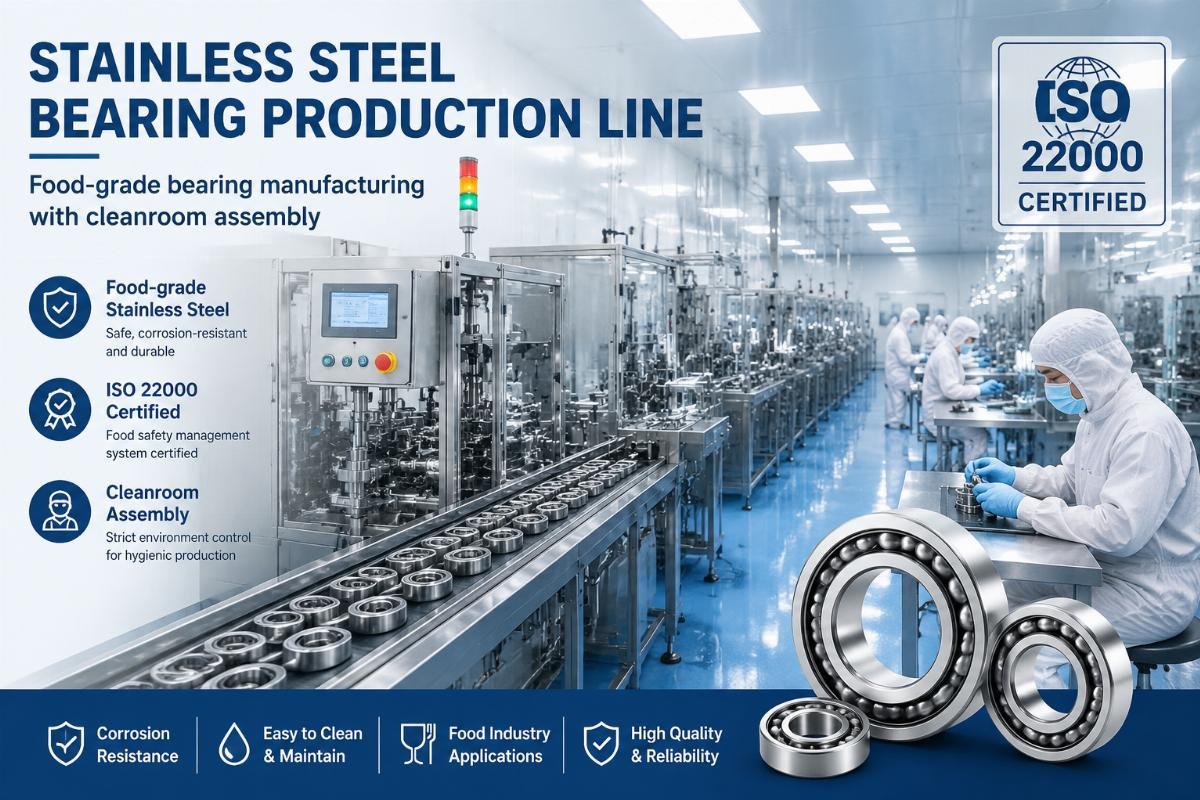
- Material Expertise – Evaluate supplier experience with your specific material requirements (e.g., 440C stainless steel for corrosion resistance)
- Inspection Capabilities – Confirm availability of coordinate measuring machines (CMM) for P4/P5 precision grade verification
- Inventory Management – Assess stock levels for standard dimensions to support emergency orders and phased delivery schedules
- Engineering Support – Verify in-house capability for application-specific modifications (e.g., modified clearance, custom seals)
- Export Experience – Check track record with your target market’s import regulations and certification requirements
What’s the Step-by-Step Process to Source OEM/ODM Bearings from Chinese Suppliers?
Successful sourcing requires treating qualification as an investment, not a cost. Rushing the supplier selection process to save time often results in production delays and quality issues later. Our optimized 5-step framework reduces qualification cycles by 40% while ensuring thorough due diligence.
| Process Stage | Primary Activities | Timeline |
|---|---|---|
| Technical Specification | Define non-standard dimensions, material specs, performance parameters | 1-2 weeks |
| Supplier Qualification | Audit certifications, production capacity, past client references | 2-3 weeks |
| Sample Testing | Dimensional accuracy, material composition, load performance testing | 3-4 weeks |
| Batch Production | Phased manufacturing with in-process inspection points | 4-8 weeks |
| Logistics Coordination | Consolidated shipping, customs documentation, delivery tracking | 1-2 weeks |
A mining equipment manufacturer in Australia needed emergency replacement of 120mm outer diameter tapered roller bearings after a conveyor system failure. Following our process, we identified a factory with C3 clearance bearings in stock, arranged same-day dispatch, and provided on-site installation guidance via video call. The entire process from initial inquiry to equipment restart took just 48 hours, minimizing production downtime to 16 hours instead of the projected 5 days.
- Requirement Documentation – Create detailed technical datasheets including ISO precision grade, clearance class, and material specifications
- Supplier Shortlisting – Identify 3-5 factories with relevant certification and production experience using Thomasnet or industry trade directories
- Sample Order – Request 5-10 pieces for destructive testing and dimensional verification against your specifications
- Production Monitoring – Schedule in-process inspections at critical manufacturing stages (e.g., heat treatment, grinding)
- Logistics Planning – Coordinate consolidated shipments to reduce freight costs and simplify customs clearance
How Can You Mitigate Risks in Chinese OEM/ODM Bearing Procurement?
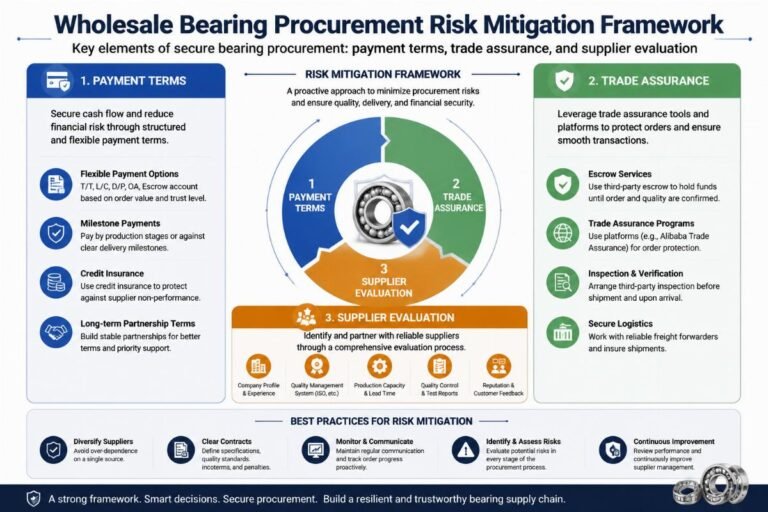
Contract terms are your best protection against supply chain disruptions. While many buyers focus on price negotiation, allocating time to develop comprehensive agreements with clear quality guarantees and delivery terms has proven to reduce disputes by 65% in our client projects.
| Risk Category | Mitigation Strategy | Implementation Method |
|---|---|---|
| Quality Deviation | Performance guarantee clause | Specify dimensional tolerance limits and material certification requirements |
| Delivery Delays | Liquidated damages provision | Include 0.5% per day penalty for late shipments beyond 5-day grace period |
| Payment Security | Phased payment schedule | Structure as 30% deposit, 50% on production completion, 20% post-acceptance |
| Intellectual Property | Confidentiality agreement | Register design patents in China with CNIPA before sharing custom specifications |
| Compliance Issues | Certification contingency |


Leave a Reply