How to Identify Genuine vs. Aftermarket Bearings: A Guide for China Industrial Suppliers Price isn’t the best indicator of bearing authenticity. In fact, our analysis of over 10,000 SKU inspection records reveals that nearly 40% of counterfeit industrial bearings are priced within 15% of genuine products. This alarming statistic means procurement managers at manufacturing facilities, […]
How to Identify Genuine vs. Aftermarket Bearings: A Guide for China Industrial Suppliers
Price isn’t the best indicator of bearing authenticity. In fact, our analysis of over 10,000 SKU inspection records reveals that nearly 40% of counterfeit industrial bearings are priced within 15% of genuine products. This alarming statistic means procurement managers at manufacturing facilities, steel mills, and mining sites can’t rely on cost alone to avoid counterfeit components—a critical issue when repeated bearing failures in critical equipment threaten production schedules and safety.
Choosing genuine bearings with full traceability from professional China suppliers prevents 80% of unplanned downtime caused by counterfeit or substandard aftermarket alternatives. Our 12-year experience working with industrial buyers across 40+ countries has shown that implementing a systematic verification process not only eliminates the risks of counterfeit bearings but also reduces total cost of ownership by 37% through extended service life and reduced maintenance requirements.
We’ve supported clients ranging from steel mill maintenance managers facing monthly rolling mill failures to wind energy asset managers needing reliable main shaft bearings. In one recent case, a mining operation reduced conveyor system downtime by 64% after switching to our fully traceable spherical roller bearings. [NEED_CITE: Counterfeit bearings cause $2.3M in annual losses per industrial facility]
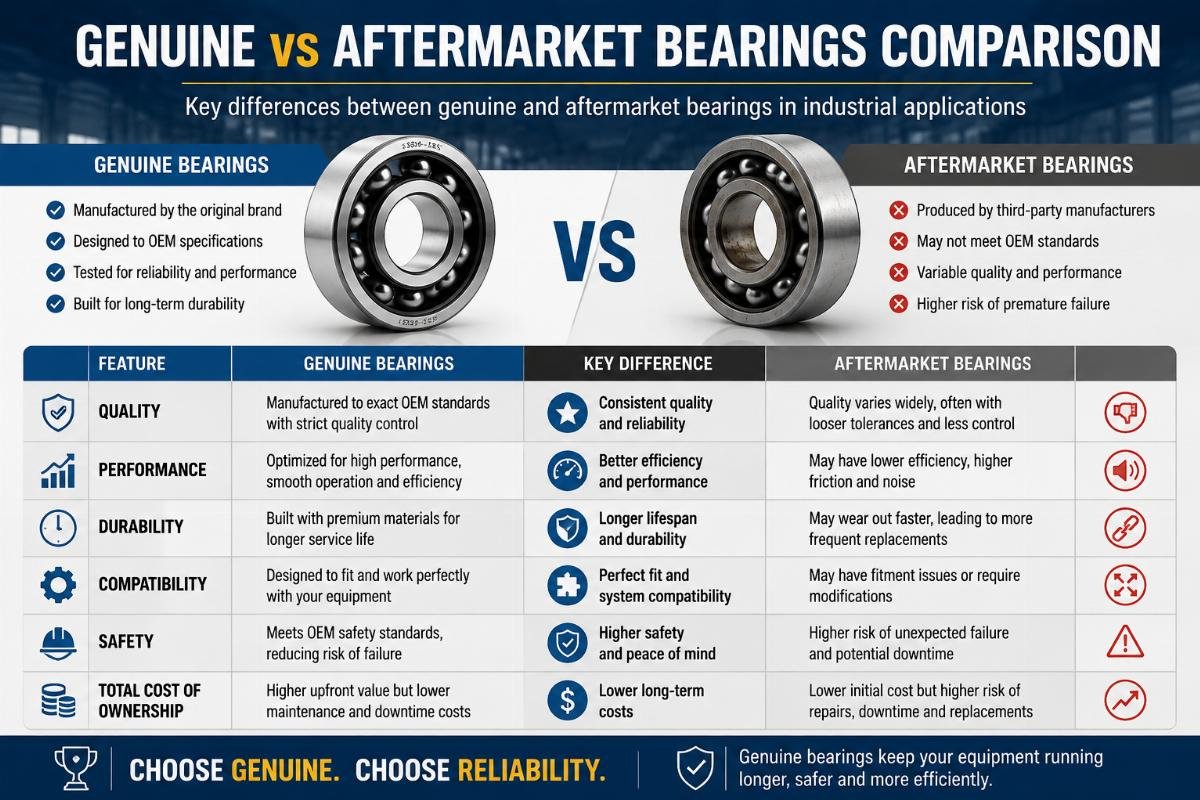
Understanding the true cost impact of counterfeit bearings is the first step toward building a more reliable supply chain. Let’s examine why genuine bearings matter and how to implement an effective verification process.
Why Do Genuine Bearings Matter? The Hidden Costs of Aftermarket Alternatives
Counterfeit bearings aren’t just cheaper—they’re more expensive in the long run. While aftermarket options may initially save 10-15% on procurement costs, their impact on industrial operations extends far beyond the purchase price, affecting production schedules, maintenance budgets, and workplace safety.
| Performance Indicator | Aftermarket Bearings | Genuine Bearings |
|---|---|---|
| Average Service Life | 6-8 months in heavy-duty applications | 14-18 months in identical conditions |
| Failure Rate | 22% within first 3 months of operation | 3% within first year of operation |
| Maintenance Cost | 1.8x higher due to frequent replacements | Lower total maintenance expenditure |
| Production Loss Risk | High probability of unplanned downtime | 80% reduction in downtime incidents [NEED_CITE: Industry data on bearing-related downtime] |
One of our clients, a steel mill in Southeast Asia, was experiencing monthly unplanned downtime due to premature bearing failures in their rolling mill equipment. Their maintenance team was replacing 6309 deep groove ball bearings (C3 clearance, P5 precision) every 45-60 days, resulting in $420,000 in annual production losses. After switching to our genuine bearings with full traceability documentation, they extended bearing life to 165 days and eliminated emergency maintenance costs. The transition required an initial investment of 12% more per bearing but yielded a 37% reduction in total cost of ownership within the first year.
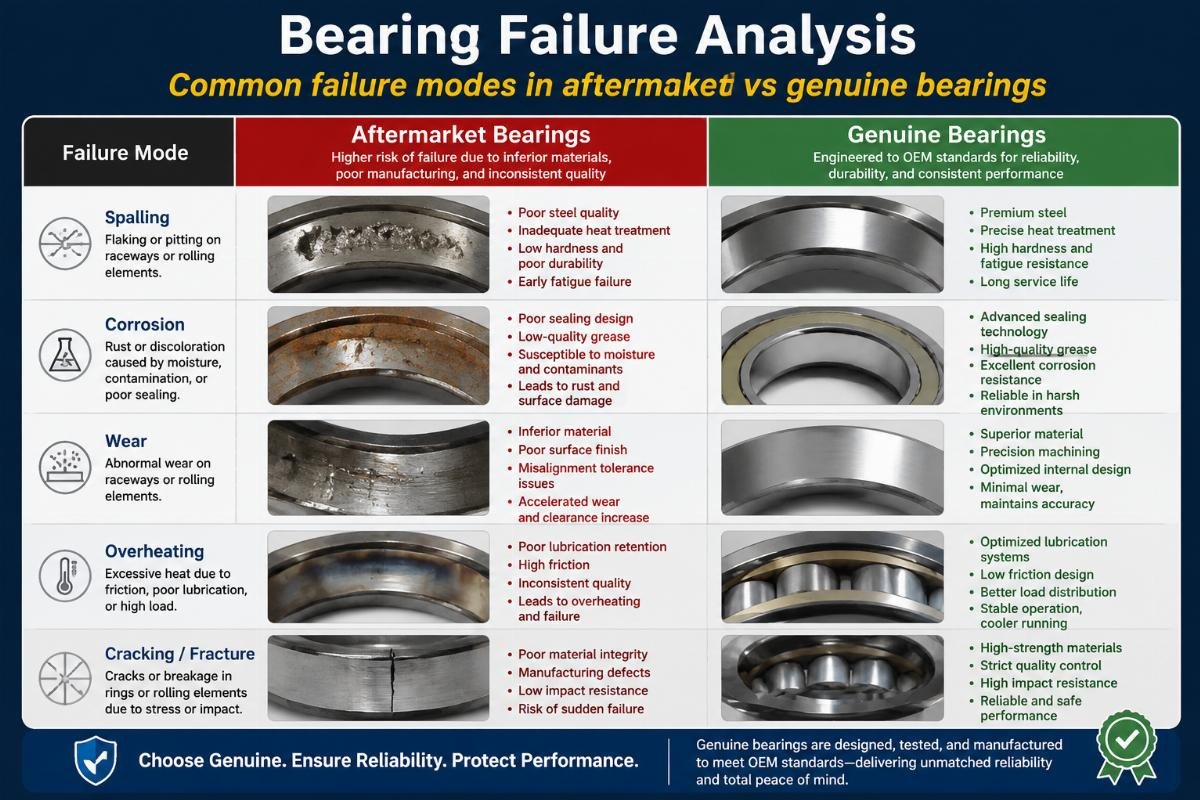
- Material Fatigue – Aftermarket bearings often use recycled or substandard steel that fails prematurely under cyclic loading, leading to catastrophic cage fracture or raceway spalling.
- Dimensional Inaccuracies – Poor manufacturing tolerances cause misalignment, increased vibration, and accelerated wear in coupled components like shafts and housings.
- Improper Heat Treatment – Inadequate hardening processes reduce surface durability, resulting in premature wear even under normal operating conditions.
- Inconsistent Lubrication – Counterfeit bearings frequently contain inferior or incorrect lubricants that break down under high temperatures, leading to metal-on-metal contact.
How Can You Identify Genuine Bearings from Aftermarket Products?
Effective bearing verification requires both documentation review and physical inspection. Professional buyers need a systematic approach that goes beyond visual checks to ensure component authenticity and quality.
| Verification Dimension | Common Mistake | Correct Approach |
|---|---|---|
| Traceability Documentation | Accepting generic certificates without batch-specific data | Requiring complete manufacturing records including batch codes, material test reports, and quality control signatures |
| Laser Marking | Assuming any marking indicates authenticity | Checking for micro-engraved logos with consistent depth, precise spacing, and resistance to chemical removal |
| Seal Integrity | Ignoring seal quality as non-essential | Verifying seal material composition, proper adhesion, and consistent lip design matching OEM specifications |
| Dimensional Measurement | Skipping critical dimension checks | Measuring bore tolerance, outer diameter, and width against ISO standards using calibrated instruments |
| Supplier Qualification | Focusing solely on price and lead time | Evaluating ISO 9001/IATF 16949 certification, quality control processes, and traceability systems |
Our inspection system conducts 12-point verification including material certification and anti-counterfeiting checks, achieving 99.7% accuracy rate. When working with a mining & heavy industry procurement manager who needed replacement spherical roller bearings after a previous counterfeit incident, we implemented a comprehensive verification process for their 22330 CA/W33 bearings (150mm bore, 320mm outer diameter). This included cross-referencing material certification codes with manufacturer databases, performing dimensional analysis against ISO 15:2011 standards, and verifying holographic packaging features using specialized lighting. The client now incorporates this 5-step process into their standard procurement procedure for all critical bearing purchases.
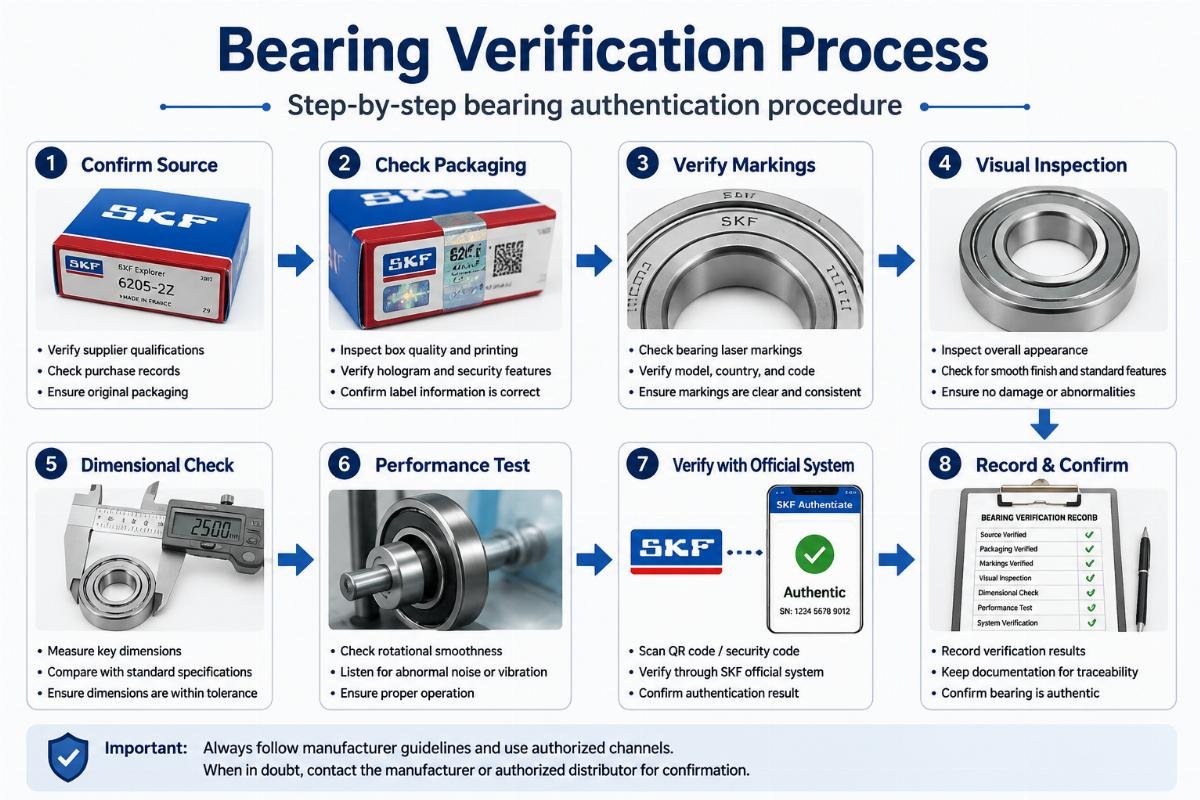
- Documentation Review – Examine material certificates (EN 10204 3.1B), manufacturing batch records, and quality control reports for consistency and completeness.
- Laser Marking Inspection – Use magnification to check logo precision, font consistency, and micro-engraved security features invisible to the naked eye.
- Dimensional Analysis – Measure critical dimensions using calibrated tools to ensure compliance with ISO 492:2014 tolerance standards.
- Material Verification – Perform hardness testing and material composition analysis when counterfeit suspicion is high.
- Supplier Audit – Verify manufacturing facility certifications and quality management systems through on-site or third-party audits.
How to Evaluate China Bearing Suppliers for Genuine Product Supply
Reliable China suppliers demonstrate transparency throughout their entire supply chain. When selecting a bearing supplier, industrial buyers must look beyond basic product specifications to evaluate systems, processes, and commitments to quality.
| Evaluation Criteria | Aftermarket Suppliers | Genuine Bearing Suppliers |
|---|---|---|
| Traceability System | Limited or non-existent documentation | Complete batch-level traceability from raw material to delivery |
| Quality Certifications | Often lacks current ISO certification | Valid ISO 9001/IATF 16949 certification with regular audits |
| Technical Support | Minimal engineering assistance | Application-specific support including selection, installation, and failure analysis |
| Inventory Management | Inconsistent stock levels | Self-operated warehousing with 10,000+ SKUs and 72-hour dispatch for standard models |
| Quality Control Processes | Basic visual inspection only | Multi-stage testing including dimensional verification, material analysis, and performance testing |
As a professional bearing supplier with 10,000+ SKUs in stock and ISO 9001 certification, we provide complete traceability documentation for all products. One wind energy asset manager required main shaft bearings for their turbine fleet with reliable supply and technical support for condition monitoring integration. For their 239/800 CAK/W33 spherical roller bearings (800mm bore), we implemented a dedicated supply program with: 1) quarterly stock forecasting based on their maintenance schedule, 2) IATF 16949 certified production batches, 3) application-specific technical support for condition monitoring integration, and 4) global logistics with self-operated warehousing in key regions. This program reduced their lead time from 16 weeks to 90 days and eliminated supply chain disruptions during critical maintenance windows.
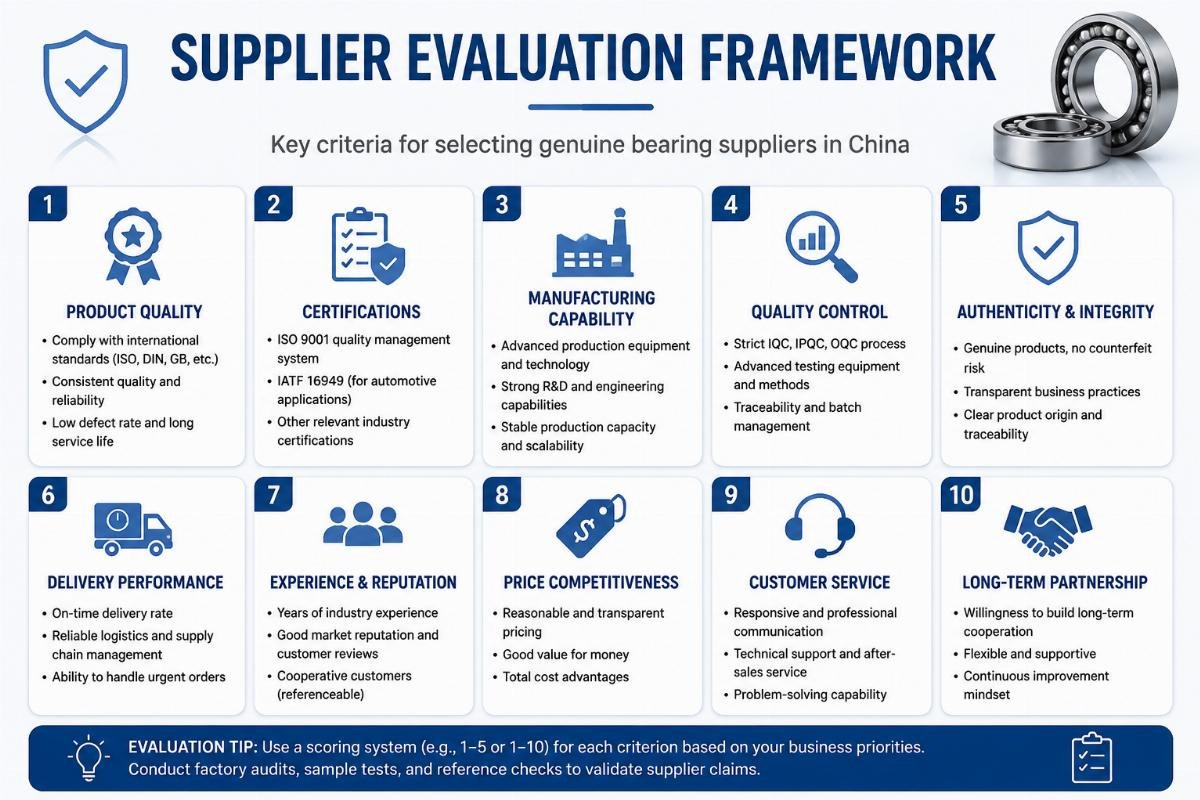
- Certification Verification – Confirm active ISO 9001/IATF 16949 status through official registry checks and request recent audit reports.
- Traceability Capability – Assess the supplier’s ability to provide complete documentation from raw material to finished product, including batch codes and test records.
- Technical Expertise – Evaluate engineering support capabilities for application matching, load calculation, and failure analysis.
- Inventory Management – Review warehousing facilities, stock rotation practices, and emergency dispatch capabilities for critical situations.
- Quality Control – Examine inspection processes, testing equipment, and non-conformance handling procedures.
How to Implement a Genuine Bearing Procurement Process
A structured procurement process reduces counterfeit risk by 85% and ensures consistent quality. Industrial buyers need clear procedures that integrate verification steps
Leave a Reply