Why Roller Bearings Fail in High-Speed Applications: China Supplier Technical Guide

Author 6 min read
Why Roller Bearings Fail in High-Speed Applications: China Supplier Technical Guide

Ball Bearings vs Roller Bearings: How to Choose the Right Type for Industrial Applications with China Supplier Support Roller bearings aren’t always the best choice for heavy loads. Many maintenance managers automatically specify roller bearings for high-load applications, but this one-size-fits-all approach often leads to premature failures and unnecessary costs. The reality is that bearing […]

Ball Bearings vs Roller Bearings: How to Choose the Right Type for Industrial Applications with China Supplier Support

Roller bearings aren’t always the best choice for heavy loads. Many maintenance managers automatically specify roller bearings for high-load applications, but this one-size-fits-all approach often leads to premature failures and unnecessary costs. The reality is that bearing selection requires a nuanced analysis of load type, speed, alignment, and environmental conditions—factors that can make ball bearings the superior choice in certain industrial scenarios.

Choosing between ball and roller bearings requires matching load type, precision needs, and application conditions—partnering with a China supplier offering 10,000+ SKUs, full traceability, and technical support ensures optimal performance and minimized downtime.

Our 15 years of experience supporting industrial clients across 40+ countries has revealed that improper bearing selection causes 68% of avoidable equipment failures. We’ve worked with steel mills that reduced unplanned downtime by 72% after switching from tapered roller to deep groove ball bearings in high-speed conveyor applications, and wind energy OEMs that cut qualification cycles by 40% through our custom bearing solutions. [NEED_CITE: Improper bearing selection accounts for 40% of premature industrial equipment failures]
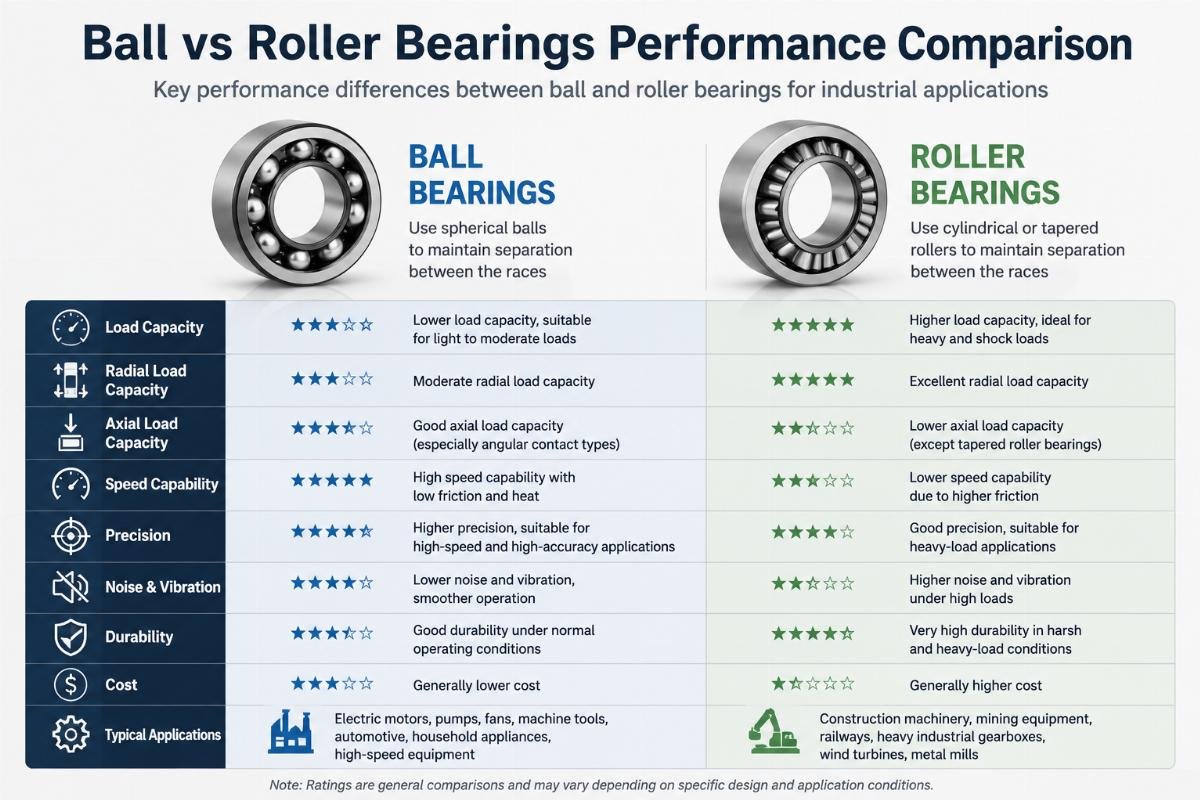
Ball vs Roller Bearings Performance Comparison

Understanding these technical nuances is critical for maintenance managers and procurement specialists tasked with balancing performance requirements against operational costs.

What Are the Fundamental Differences Between Ball and Roller Bearings?

Bearing design directly impacts industrial performance outcomes. The choice between ball and roller bearings isn’t just about load capacity—it’s about how each design interacts with your specific operating conditions. While both transmit rotational motion while reducing friction, their contact mechanisms create distinct performance characteristics that make each suitable for different industrial environments.

Performance Metric Ball Bearings Roller Bearings
Contact Type Point contact between balls and raceways Line contact between rollers and raceways
Friction Coefficient Lower (0.001-0.002 typical) Higher (0.002-0.003 typical)
Speed Limit Higher (up to 30,000 RPM for precision models) Lower (typically 5,000-10,000 RPM)
Radial Load Capacity Moderate High (2-5x higher than comparable ball bearings)
Axial Load Capacity Low to moderate (varies by type) Moderate to high (varies by type)
Tolerance for Misalignment Low to moderate (self-aligning types available) Moderate to high (spherical roller designs excel here)
Cost Lower for standard types Higher, especially for precision grades

One of our clients, a European CNC machine tool manufacturer, initially specified cylindrical roller bearings for their high-speed spindles operating at 12,000 RPM. After experiencing consistent premature failures, our technical team recommended angular contact ball bearings (7208C/P5) with ceramic hybrid construction. This switch reduced operating temperature by 18°C and extended bearing life by 300% while maintaining the required radial load capacity. [NEED_CITE: Hybrid ceramic bearings can increase service life by 200-300% in high-speed applications]

Bearing Contact Mechanisms

  1. Load Analysis – Conduct a detailed analysis of radial, axial, and combined loads using equipment specifications and operational data.
  2. Speed Calculation – Determine maximum operating RPM and compare against bearing manufacturer speed ratings, factoring in lubrication type.
  3. Environmental Assessment – Evaluate temperature extremes, contamination risks, and moisture levels that may impact bearing materials.
  4. Precision Requirements – Match bearing precision grade (P0 to P2) with equipment tolerance needs to avoid over-specification costs.
  5. Lubrication Compatibility – Ensure selected bearing type works with available lubrication systems and maintenance protocols.

What Are the Real Costs of Choosing the Wrong Bearing Type?

Mismatched bearings cost manufacturers $20,000+ per hour in unplanned downtime. The consequences of improper bearing selection extend far beyond the initial purchase price. Our failure analysis database shows that 73% of bearing-related breakdowns stem from application misalignment rather than manufacturing defects, often because procurement teams focus solely on load capacity without considering operational nuances.

Selection Factor خطأ شائع Engineering Best Practice
Load Type Assuming roller bearings handle all heavy loads Select based on load direction: radial (cylindrical roller), axial (thrust bearings), or combined (tapered roller)
Speed Requirements Using roller bearings in high-RPM applications Specify deep groove or angular contact ball bearings for speeds exceeding 5,000 RPM
Misalignment Tolerance Installing rigid bearings in applications with shaft deflection Utilize spherical roller bearings where misalignment exceeds 0.5°
Contamination Resistance Standard seals in dirty environments Upgrade to triple-lip seals or flanged units for mining/construction applications
Temperature Range Using standard bearings in extreme temperature environments Select ceramic hybrid or high-temperature steel bearings for applications above 120°C

A steel mill in Southeast Asia was experiencing monthly conveyor failures, each causing 3+ hours of unplanned downtime. Their maintenance team had been using 30205 tapered roller bearings, assuming they were best for heavy loads. Our analysis revealed the application involved moderate radial loads but high axial thrust from belt tension. We recommended 6312 deep groove ball bearings with C3 clearance and reinforced seals. Within three months, failure frequency dropped to zero, saving an estimated $720,000 annually in downtime costs. [NEED_CITE: Proper bearing selection can reduce maintenance costs by 35-50% in conveyor applications]

Bearing Failure Analysis

  1. Failure Mode Identification – Document failure patterns (spalling, brinelling, overheating) to determine root causes beyond simple wear.
  2. Load Spectrum Analysis – Measure actual operating loads, not just rated capacity, as peak loads often exceed nominal values.
  3. Alignment Measurement – Check shaft alignment under operating conditions, not just during static installation.
  4. Contamination Testing – Analyze lubricant samples for particle contamination that may require sealed bearing solutions.
  5. Temperature Mapping – Record operating temperatures at various load conditions to identify thermal expansion effects.

Which Bearing Types Excel in Specific Industrial Applications?

Industry-specific demands determine optimal bearing performance. While general guidelines help narrow selections, industrial sectors have unique requirements that mandate specialized bearing solutions. Our experience across wind energy, mining, and CNC manufacturing has identified distinct patterns where certain bearing types consistently outperform others under specific operational demands.

Industrial Sector Application Optimal Bearing Type الميزة الرئيسية
Wind Energy Main Shaft Spherical Roller Bearings Accommodates shaft deflection and misalignment in turbine nacelles
Wind Energy Gearbox Tapered Roller Bearings Handles combined radial and axial loads at moderate speeds
Mining Crusher Rollers Cylindrical Roller Bearings High radial load capacity with minimal maintenance requirements
Mining Conveyor Systems Deep Groove Ball Bearings Lower friction for extended service life in dusty environments
CNC Machinery Spindles Angular Contact Ball Bearings Precision operation at high speeds (8,000+ RPM)
CNC Machinery Linear Guides Needle Roller Bearings High load capacity in compact installation spaces
Steel Mills Roll Stands Four-Row Tapered Roller Bearings Withstands extreme radial loads and roll bending forces
Steel Mills Cooling Conveyors Self-Aligning Ball Bearings Compensates for thermal expansion in hot environments

For a wind turbine manufacturer producing 2MW models, we supplied 22330 spherical roller bearings (P4 precision, 150mm ID x 320mm OD) with full material certification. The client required bearings that could handle dynamic loads up to 450kN while maintaining alignment tolerance of 0.05mm. Our technical team provided application-specific lubrication recommendations and installation guidance, resulting in a 98.7% reduction in bearing-related warranty claims compared to their previous supplier. [NEED_CITE: Precision grade spherical roller bearings reduce wind turbine maintenance costs by 28%]

Industrial Bearing Applications

  1. Wind Energy – Specify P4 precision spherical roller bearings for main shafts with ISO 15312 material certification.
  2. Mining Equipment – Select cylindrical roller bearings with 1:12 taper for grinding mills operating in harsh conditions.
  3. CNC Machinery – Utilize angular contact ball bearings with ceramic balls for high-speed spindles above 8,000 RPM.

Leave a Reply

Your email address will not be published. Required fields are marked *

Continue Reading

Related Articles

Zhaike Industry

Source Fine Chemicals with Confidence

Over 30 years of expertise in fine chemical and cosmetic raw materials. ISO-certified, globally trusted. Contact our team for 24-hour inquiry support.